

 By
By Introduction
Finding a court is easy; knowing where to find trustworthy competition information is harder. A player may want to book a first game, join a tournament, understand a rating, or enter a league, yet find similarly named websites giving very different kinds of information. NLPadel matters because it connects Dutch players to practical, official routes into the sport.
This guide explains the platform, its services, and how beginners, regular players and clubs can use trustworthy information with confidence.
What Is NLPadel and Why Does Its Official Role Matter?
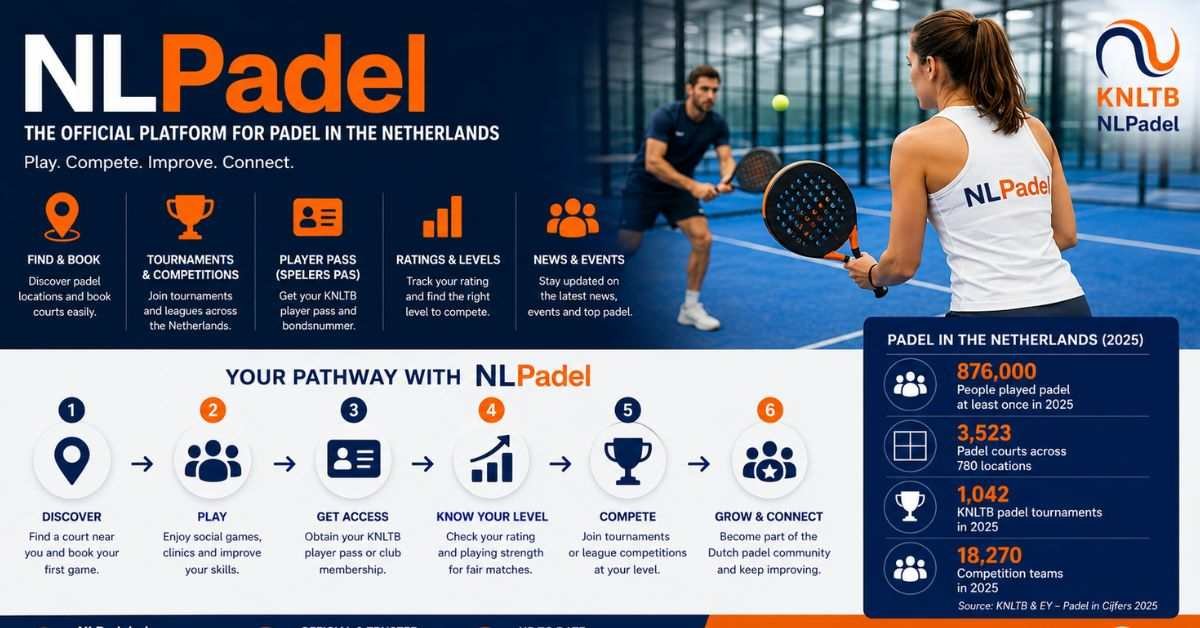
NLPadel is the KNLTB platform for padel players and fans in the Netherlands. It helps people discover the sport, find places to play, book courts through Meet & Play, explore tournaments and competitions, and learn about rating, playing strength and top-level events.
The distinction matters because the similarly named .org page publishes an editorial article describing a broad “smart padel ecosystem,” while the .nl platform links into KNLTB player services and Dutch competition information. A reader searching NLPadel should therefore rely on the .nl platform for official participation details and use third-party articles only for broader background.
| Reader need | Where the official platform helps | Why it matters |
| Try padel locally | Location finder and court booking route | You can move from interest to a real booking |
| Play structured matches | Competition and tournament information | You can choose the right competitive route |
| Track level | Playing strength and rating guidance | You can seek balanced matches |
| Follow the sport | News, events and top-padel coverage | You stay connected beyond your own court |
This official role has become more useful as NLPadel grows. The KNLTB and EY reported that 876,000 people in the Netherlands played padel at least once in 2025, while 343,121 players were registered through the KNLTB.
What Can Players, Clubs and Newcomers Do on NLPadel?
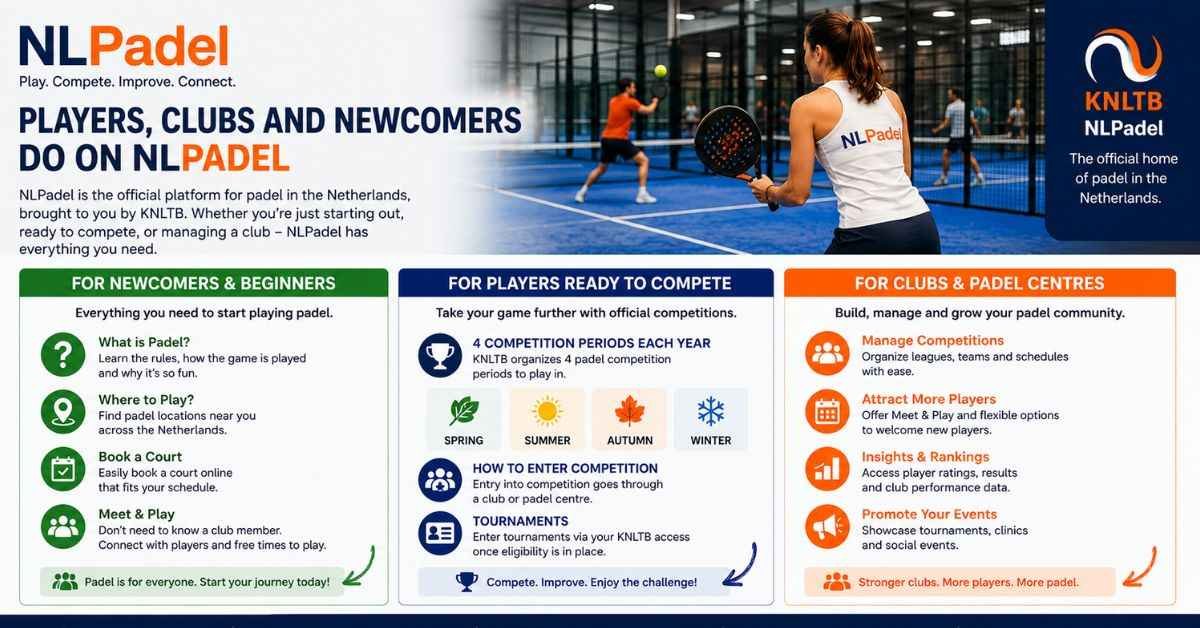
For a beginner, the platform answers the first practical questions: what the game is, how it works and where to play. To book a close court, people don’t need to know a club member; the Meet & Play route connects people with free times to play.
For players ready for competition, the official offering is more specific. KNLTB lists four padel competition periods through the year: spring, summer, autumn and winter. Entry into competition goes through a club or padel centre, while tournament entry can be handled through the player’s KNLTB access once eligibility is in place.
The player-pass information closes a gap that many broad community articles overlook. A person who is not a member of a KNLTB club can obtain a KNLTB Spelerspas for access to approved tournaments and competitions. It gives you a bondsnummer, access to MijnKNLTB, a playing strength and grade, but it doesn’t give you free court-playing rights at a facility.
Ratings are not just a label beside a name. Playing strength is a whole number used for competition line-ups and tournament entry, while the rating changes after official results and supports more precise tournament placement. From 1 January 2025, KNLTB introduced an updated padel rating calculation that considers games won and lost and different pair combinations, aiming for more balanced competition.
| Official function | Beginner example | Regular-player example | Club or centre value |
| Court discovery | Book an introductory session nearby | Find an extra game outside training | Reach new flexible players |
| Player pass | Enter approved events without club membership | Keep one official playing profile | Welcome non-members into events |
| Rating and level | Understand suitable opponents | Track progress after matches | Build fairer team placement |
| Competition calendar | See what league play involves | Plan a season with a team | Organise registrations and fixtures |
The official research report recorded 1,042 KNLTB NLPadel tournaments in 2025, up from 772 in 2024, and 18,270 competition teams in 2025. The figures show a broad competitive pathway beyond social games.
How to Use NLPadel to Start Playing or Competing
Use NLPadel by first choosing whether you want a casual booking, a tournament or team competition; then find a location, arrange the required KNLTB access, choose an event at your level, and confirm the latest rules before you play.
- Decide how you want to play: Choose a one-off court booking if you are exploring the sport, a tournament if you want individual event experience, or competition if you want a season with a team.
- Find a suitable location: Use the location or booking route to check nearby padel options. For new players, a beginner clinic or a first match with friends is often a better start than entering competition immediately.
- Get the right access for official matches: A club member normally receives a KNLTB bondsnummer through membership. A flexible player can check whether the Spelerspas is the suitable route for approved tournaments and competition.
- Match the event to your level: Use playing strength and rating guidance rather than choosing an event only by date or distance. Balanced matches are more enjoyable and give better feedback on your development.
- Check the live details before committing: Registration deadlines, season arrangements, regulations and player-pass conditions are time-sensitive. Confirm these on the official pages and with the organising club or centre.
A useful real-life path is simple: a newcomer books a court locally, plays several social matches, takes a lesson, obtains the correct player access once ready, enters a level-suitable tournament, and later joins a competition team through a facility. That sequence lowers pressure while creating steady progress.
Common Mistakes When Using NLPadel Information Online
Mistake 1: Assuming every similar domain is an official service
General articles can inspire readers, but they should not be used to confirm tournament eligibility, pass benefits, rating rules or league registration. Verify action-based information through the KNLTB platform.
Mistake 2: Buying access without understanding what it includes
A player pass gives a pathway into official match play, but it is not the same as club membership or unlimited court access. Always review what a facility charges and allows separately.
Mistake 3: Ignoring rating and entering the wrong level
Picking a bracket that is too high can create one-sided matches; choosing far below level is unfair to others. Your rating and playing strength exist to support enjoyable, competitive play.
Mistake 4: Treating a dated article as a live calendar
NLPadel is changing quickly: the 2025 research figures show strong growth in locations, tournaments and teams. Use articles for orientation and official event pages for current decisions.
Pro Tips and Best Practices for Dutch Padel Players
Start with your goal. Social players may need a court and partners; developing competitors may need coaching, official matches and a way to measure progress.
Use official data to choose realistic next steps. In 2025, the Netherlands counted 3,523 padel courts across 780 locations, so availability is improving nationally, although popular locations may still be busy. Look beyond your closest peak-time slot if you struggle to find a booking.
Treat your rating as guidance, not status. Track patterns in your matches: repeated close losses may point to tactics and positioning, while wide score gaps may mean your event choice is not yet suitable. A coach or experienced partner can help turn results into a focused training plan.
Finally, check NLPadel again at the point of registration. Event formats, regulations, pass terms and competition dates can be updated between the day you research and the day you enter.
FAQs
Is NLPadel the official website for padel in the Netherlands?
Yes. NLPadel on the .nl domain is presented as the KNLTB platform for Dutch padel players and fans, with paths to competitions, tournaments, booking, ratings and player access. The similarly named .org page presents editorial content and does not show the same official service role in its inspected page content.
Do I need a membership to play in official tournaments or competitions?
You need KNLTB access for approved match play, but that does not always mean club membership. A KNLTB club member receives a bondsnummer through membership; a flexible player can use a Spelerspas route. Competition entry still needs coordination with a club or padel centre.
How does a Dutch padel rating work?
A Dutch padel rating changes after eligible official matches and helps place players at a suitable level. KNLTB states that its updated model considers match results, games won and lost, and pair combinations. Playing strength is the yearly whole-number level used for entries and team placement.
Can a Spelerspas be used to book and play freely at any club?
No. The KNLTB Spelerspas provides access to the official competition and tournament pathway, a bondsnummer and player-profile benefits, but it does not give automatic free-play rights at a padel facility. Court bookings, fees and availability remain subject to the provider’s arrangements.
What is the easiest way for a complete beginner to begin?
The easiest start is to find a nearby location, book an introductory court session or lesson, and play socially before entering an official event. Once you can serve, score and use the walls safely, a level-appropriate tournament can be a good next step.
Why is official information important when NLPadel is growing quickly?
Official information matters because schedules, regulations, ratings and access rules can change as participation grows. KNLTB/EY data recorded 876,000 people playing padel at least once in 2025 and more than 1,000 KNLTB tournaments, making a dependable current source especially valuable.
Conclusion
Dutch padel now offers much more than a casual court booking: players can move from first games to rated tournaments, seasonal team competitions and a wider national community. Using official information helps each step feel clear, fair and suited to your level.
For anyone wanting to play, compete or understand padel in the Netherlands, NLPadel is the practical place to begin. Use it to explore local options, understand official pathways and confirm current details before registering, because the sport and its opportunities continue to develop quickly.