

 By
By Introduction
Organizations today face constant pressure to modernize their technology stacks, adopt AI, and scale digital transformation initiatives. Yet many transformation programs fail—not because of lack of ambition, but because leaders lack clear, evidence-based insights into their organization’s real capabilities.
Traditional consulting assessments often rely on interviews, workshops, and subjective evaluations. While useful, these approaches can miss hidden patterns buried in documentation, strategy papers, architecture diagrams, or internal reports.
This area is where the Capabilisense platform introduces a new approach.
Instead of relying solely on opinions or manual reviews, the platform uses AI to analyze unstructured documents and generate objective capability assessments and transformation roadmaps.
In this guide, we’ll explore how the Capabilisense platform works, why organizations are adopting it, and how it helps leaders move from vague transformation goals to actionable strategies backed by data.
What Is the CapabiliSense Platform?
The Capabilisense platform is an AI-powered system designed to automate organizational capability assessment and transformation planning.
It analyzes unstructured sources such as:
- Strategy documents
- Architecture diagrams
- Cloud migration plans
- Internal reports
- Technical documentation
- Business process manuals
By processing this information, the platform identifies capability gaps across areas such as
- Cloud strategy
- IT governance
- AI adoption readiness
- Digital architecture maturity
- Data management practices
Rather than producing generic recommendations, the Capabilisense platform generates evidence-based insights and structured transformation roadmaps.
Many organizations describe the system as a “GPS for transformation” because it shows where the organization currently stands and what steps are needed to reach future capability targets.
Why Traditional Capability Assessments Often Fail
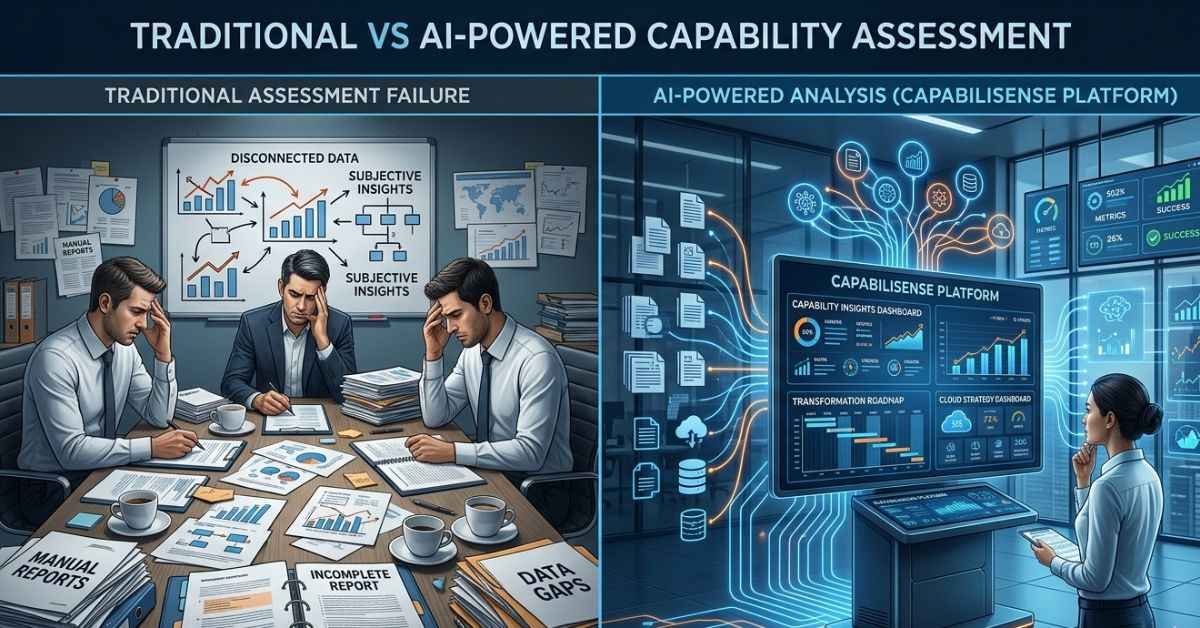
Before exploring how the Capabilisense platform works, it’s important to understand why many traditional assessments struggle.
Heavy Dependence on Interviews
Consultants typically gather information through stakeholder interviews.
This creates two problems:
- Responses may be biased or incomplete.
- Important details hidden in documentation may never surface.
Limited Data Coverage
Organizations generate enormous volumes of documentation.
Manual reviews simply cannot process all of it efficiently, leading to potential oversights and inaccuracies in the assessment of the documentation.
Subjective Scoring
Capability maturity models frequently rely on human scoring frameworks, which may differ based on the evaluator.
According to a McKinsey digital transformation study, nearly 70% of transformation initiatives fail to meet their objectives, often due to misaligned strategy or inaccurate capability assessment.
The Capabilisense platform addresses these issues by applying machine learning to large volumes of internal documents, reducing bias and improving evidence quality.
How the CapabiliSense Platform Works
At its core, the Capabilisense platform combines natural language processing (NLP), document analysis, and transformation frameworks.
The system typically operates in four stages.
Document Ingestion
Organizations upload relevant materials such as
- IT strategy documents
- Cloud architecture diagrams
- Security frameworks
- AI initiatives
- Process documentation
The platform supports structured and unstructured content formats.
AI-Driven Document Analysis
Using NLP and machine learning models, the Capabilisense platform scans documents to identify signals related to:
- capability maturity
- technology strategy alignment
- governance practices
- operational processes
It extracts patterns that human reviewers might miss.
Capability Gap Detection
The platform compares detected signals against transformation frameworks.
These frameworks may include:
- Cloud maturity models
- Enterprise architecture standards
- AI readiness frameworks
- IT governance benchmarks
Actionable Transformation Roadmaps
Finally, the system generates data-backed recommendations for capability improvements.
Instead of broad advice, organizations receive:
- prioritized initiatives
- transformation milestones
- capability improvement pathways
The result is a structured plan that helps leadership teams move from analysis to execution, ensuring that they can effectively implement the identified capability improvement pathways and achieve their transformation milestones.
Core Capabilities of the CapabiliSense Platform
The table below summarizes the major functions of the Capabilisense platform.
| Capability | Description | Business Value |
| Document Intelligence | AI analyzes unstructured documents and extracts capability signals | Reduces manual review workload |
| Capability Gap Analysis | Identifies weaknesses across IT, AI, and cloud strategies | Enables objective transformation planning |
| Transformation Roadmaps | Generates prioritized improvement steps | Helps leadership align investments |
| Evidence-Based Insights | Recommendations backed by document analysis | Improves trust in transformation decisions |
Real-World Example: Cloud Transformation Assessment
Imagine a mid-size enterprise preparing for a cloud modernization program.
The leadership team has hundreds of documents:
- migration proposals
- architecture diagrams
- governance policies
- vendor contracts
Reviewing all these materials manually would take months.
By using the Capabilisense platform, the organization can:
- Upload relevant documents.
- Allow the system to analyze strategy alignment.
- Detect gaps in governance and architecture readiness.
- Generate a prioritized transformation roadmap.
The result is a faster, more reliable assessment compared with traditional consulting approaches, leading to more effective governance and architecture readiness evaluations.
Key Benefits of the CapabiliSense Platform
Organizations adopting the Capabilisense platform often report improvements in three main areas.
Faster Transformation Planning
Automated document analysis dramatically reduces time spent reviewing internal materials.
Instead of weeks of manual review, organizations can obtain insights in days.
Evidence-Based Decision Making
The Capable platform generates recommendations grounded in documented evidence rather than opinions.
This helps leadership teams:
- justify investments
- align stakeholders
- prioritize transformation initiatives
Reduced Consulting Bias
Traditional assessments can vary depending on the consulting team involved.
AI-driven analysis ensures consistent capability scoring across assessments.
CapabiliSense Platform vs. Traditional Consulting
| Feature | Traditional Consulting | CapabiliSense Platform |
| Assessment Method | Interviews & workshops | AI document analysis |
| Speed | Weeks or months | Days |
| Data Coverage | Limited samples | Large document sets |
| Consistency | Varies by consultant | Algorithmic consistency |
| Output | Reports & recommendations | Data-driven transformation roadmaps |
This doesn’t necessarily replace consulting expertise but augments it with evidence-driven analysis.
In fact, platforms like the Capabilisense platform often highlight in their discussions how AI-assisted assessment can improve consulting outcomes.
Related Transformation Areas the Platform Supports
The Capabilisense platform is not limited to IT modernization.
Organizations also use it for assessments across multiple domains:
Cloud Transformation
Evaluates readiness for migration, governance frameworks, and architecture design.
AI Strategy Development
Assesses data maturity, AI governance models, and implementation readiness.
Enterprise Architecture Alignment
Identifies inconsistencies between strategy and technical infrastructure.
Digital Capability Maturity
Analyzes processes and digital adoption levels across departments.
These capabilities help organizations build holistic transformation strategies rather than fragmented initiatives.
Common Mistakes Organizations Make When Planning Transformation
Even with advanced tools like the Capabilisense platform, transformation initiatives can fail if organizations make common mistakes.
Ignoring Documentation
Important insights often reside in old strategy documents or architecture diagrams.
Failing to analyze these materials leads to incomplete assessments.
Overlooking Governance Structures
Many transformations focus only on technology upgrades while ignoring governance and processes, which can result in misalignment between technological advancements and organizational objectives.
Lack of Prioritization
Organizations sometimes attempt too many initiatives simultaneously, which can lead to confusion and diluted efforts across projects.
A roadmap generated by the Capabilisense platform helps prioritize efforts based on capability gaps, ensuring that organizations focus on the most critical initiatives first to avoid spreading resources too thin.
Pro Tips for Getting Maximum Value from the Platform
To maximize outcomes when using the Capabilisense platform, organizations should follow several best practices.
Upload Comprehensive Documentation
Include strategy papers, architecture plans, and operational guidelines.
More data improves analysis quality.
Combine AI Insights with Expert Review
The platform provides evidence-based insights, but leadership teams should still validate results with domain experts.
Use Results to Align Stakeholders
Transformation roadmaps generated by the Capabilisense platform can help executives communicate strategic priorities clearly.
Building Trust in AI-Driven Capability Assessments
Trust is a critical factor when organizations adopt AI-based transformation tools.
Research from Gartner indicates that over 60% of enterprise leaders prefer data-backed transformation insights over purely opinion-driven consulting recommendations.
The Capabilisense platform builds credibility through:
- evidence-based analysis
- transparent capability scoring
- traceable document insights
Professionals discussing the technology on the Capabilisense platform on LinkedIn.com often emphasize how AI-assisted assessments can support strategic decision-making by providing data-driven insights and enhancing the accuracy of evaluations.
FAQs
What is the CapabiliSense platform used for?
The Capabilisense platform helps organizations assess their technological and operational capabilities by analyzing internal documents and generating transformation roadmaps.
How does the CapabiliSense platform analyze documents?
The system uses natural language processing and machine learning to identify patterns related to governance, architecture maturity, and transformation readiness.
Can the platform replace consulting firms?
Not necessarily. Many organizations use the Capabilisense platform alongside consulting services to enhance evidence-based analysis.
What industries can use the platform?
The Capabilisense platform is suitable for organizations undergoing digital transformation in industries such as finance, healthcare, technology, and manufacturing.
Does the platform support AI strategy planning?
Yes. The Capabilisense platform can evaluate data maturity, governance readiness, and AI implementation frameworks.
Is document quality important for accurate analysis?
Yes. High-quality documentation improves the platform’s ability to identify capability gaps and generate reliable recommendations.
Conclusion
Digital transformation is complex, and many initiatives fail because organizations start without a clear understanding of their current capabilities.
The Capabilisense platform introduces a new approach: AI-driven capability assessment powered by document intelligence.
By analyzing internal documentation, the platform helps organizations:
- identify transformation gaps
- develop evidence-based roadmaps
- align technology strategies with business goals
As enterprises continue investing in cloud, AI, and digital modernization, tools like the Capabilisense platform may become essential for guiding transformation with data rather than assumptions.
Visit the rest of the site for more interesting and useful articles.