
 By
By Introduction
Many people search for Tallyman Axis because they see the term linked with Axis Bank collections or login pages, but the online explanations are often confusing. Some make it sound like a customer banking app. Others describe it as a data visualization tool.
The clearer answer is this: it belongs in the niche of enterprise banking software for debt management, collections, and recovery operations. It is not the same as Axis Mobile, internet banking, or a public payment dashboard for retail customers.
This article explains what the system means, who may use it, how it supports collection operations, and what normal customers should know before trusting any login or recovery-related message.
Why Tallyman Axis Is Often Misunderstood Online
The confusion starts because the phrase combines two familiar words. “Tallyman” is the name of Experian’s debt collection and recovery software, while “Axis” points to Axis Bank’s use of that software in India.
Tallyman Axis should not be explained as a general money-management app. Experian’s announcement says Axis Bank selected Tallyman to manage customers in arrears, reduce collection costs, and improve recovery outcomes. It also says the software supports the collections lifecycle from high-risk pre-delinquent accounts to debt recovery.
That makes the topic closer to:
- Debt collection software
- Loan recovery workflow management
- Banking operations technology
- Arrears portfolio segmentation
- Internal collection-agent tools
A normal borrower may hear about a collection call, overdue EMI, or recovery follow-up. But that does not mean the borrower can access the internal tool.
| Common online claim | More accurate explanation |
| It is a public Axis Bank app | It appears linked to internal debt-management and collection workflows |
| Any customer can sign up | Access should be limited to authorized bank users, vendors, or agents |
| It is mainly for budgeting | Its verified context is arrears, collections, and recovery operations |
| Login pages are safe if they rank | Users should verify access only through official Axis Bank channels |
How Tallyman Axis Fits Into Enterprise Debt Management
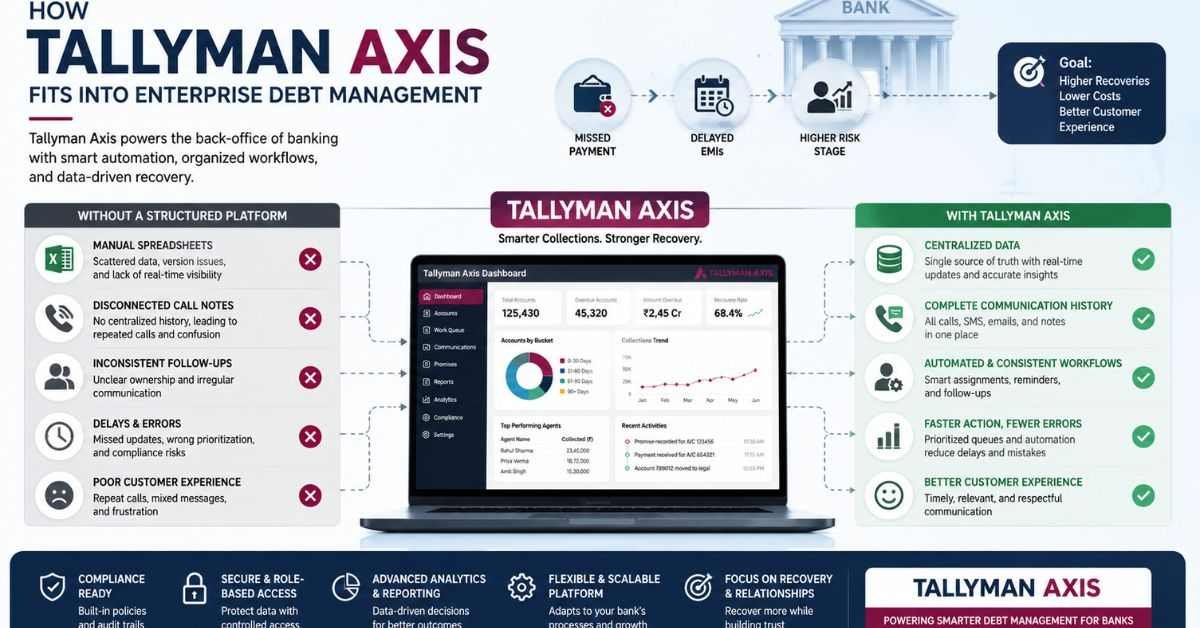
Tallyman Axis fits into the back-office side of banking. In simple terms, a bank needs organized systems when a borrower misses payments, delays EMIs, or moves into a higher-risk repayment stage.
Without a structured platform, collection teams may depend on manual spreadsheets, disconnected call notes, and inconsistent follow-ups. That can create delays, errors, repeat calls, and poor customer experience.
A debt-management platform helps teams work with clearer rules. Experian describes its debt recovery tools as supporting customer-focused collections, account prioritization, and assessment of ability and propensity to pay.
In a banking environment, this type of system can help with:
- Flagging overdue accounts by risk level
- Assigning cases to the right team or agency
- Recording communication history
- Automating reminders where allowed
- Tracking repayment promises and settlement status
- Escalating serious cases for review
- Creating reports for managers and compliance teams
This matters because collection is not only about recovering money. It is also about treating borrowers fairly, protecting private data, and following regulatory rules.
Axis Bank also has public-facing cash management and collection services for businesses, including collection solutions through many locations and automated receivables reconciliation. These public business services should not be confused with internal debt recovery software.
| User type | Likely relationship to the system |
| Retail banking customer | No normal public access |
| Borrower with overdue loan | May be contacted by authorized bank or agency staff |
| Collection agent | May use assigned internal tools if authorized |
| Bank manager | May use reports, workflows, and portfolio tracking |
| Blogger/researcher | Should explain it as B2B banking software, not a customer app |
What Is Tallyman Axis? Direct Definition
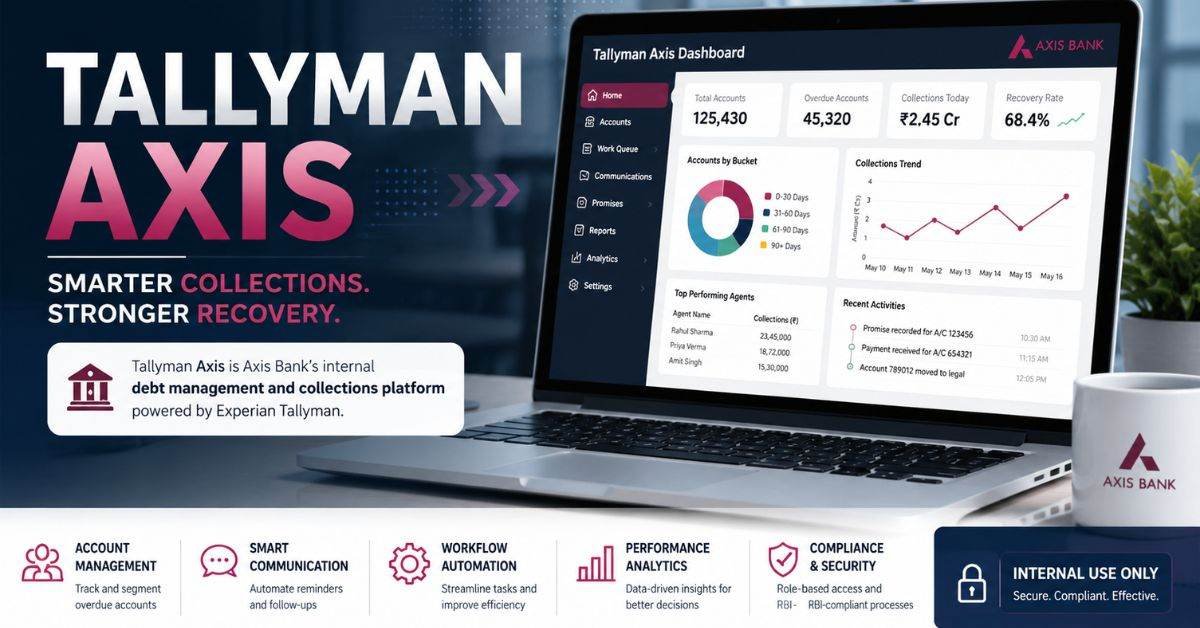
Tallyman Axis is best understood as Axis Bank’s use of Experian’s Tallyman debt management software for internal collections, arrears tracking, and recovery workflows. It is designed for authorized banking and collection teams, not for regular retail customers.
The system’s purpose is to help a financial institution manage overdue accounts more consistently. It can support automation, case segmentation, reporting, and controlled follow-up actions.
Experian’s Tallyman material also mentions automation for pre-delinquency and early collections, pre-built treatment strategies, and the ability to tailor strategies without custom programming.
A practical example makes this easier to understand.
Imagine a customer misses two loan EMIs. The bank may need to classify the case, check risk, assign a follow-up route, record contact attempts, and track whether the customer promises to pay. A debt-management system helps organize those steps so teams do not work blindly.
Common Mistakes
Many readers make the same mistakes when searching this topic. These mistakes can lead to wrong information or even unsafe browsing.
- Treating Tallyman Axis as a retail login portal: A normal Axis Bank customer should use official Axis Bank channels for banking, loan status, or payments.
- Trusting random login pages: Search results can include third-party pages that are not official. This is risky for usernames, passwords, and financial data.
- Ignoring borrower rights: If a recovery agent contacts a borrower, the communication should follow lawful and respectful practices.
- Mixing collection services with debt recovery software: Business collection products, payment gateways, and recovery case-management tools serve different purposes.
- Assuming all online steps are valid: Internal enterprise systems can change, move, or require VPN, employee credentials, vendor access, or bank-controlled authentication.
RBI guidance says banks should conduct due diligence when engaging recovery agents and ensure agents are properly trained on sensitive responsibilities such as calling hours and customer privacy.
Pro Tips / Best Practices
When explaining Tallyman Axis, use a cautious and accurate approach. The safest framing is: “an internal enterprise collection and debt-management system associated with Axis Bank’s use of Experian Tallyman.”
For borrowers, the best practice is simple: do not enter credentials, OTPs, loan details, or personal information on any random page that claims to be a collection portal. Contact Axis Bank through official customer support, branch channels, or verified app/website routes.
For content writers, avoid promising that readers can “sign up” or “create an account.” That may be inaccurate and unsafe. Instead, explain that access is likely restricted to authorized employees, collection partners, or internal users.
For banks and collection teams, the best practices are different:
- Keep access role-based and monitored.
- Record case updates clearly.
- Use customer segmentation responsibly.
- Avoid aggressive recovery language.
- Keep borrower data private.
- Train agents on compliance and escalation.
RBI’s digital lending FAQ also says that when a recovery agent is assigned after delinquency, the borrower should receive the agent’s particulars through email or SMS before the agent contacts them.
This area may change further. In 2026, India’s central bank proposed stricter rules for recovery agents, including tighter controls on borrower privacy, monitoring of agent conduct, and restrictions on harsh recovery methods.
FAQs
Is Tallyman Axis a customer banking app?
No. Tallyman Axis is not best understood as a normal customer banking app. Its verified context is enterprise debt management and collections. Retail customers should use official Axis Bank apps, internet banking, branches, or customer care for account access.
Can borrowers log in to Tallyman Axis?
In most cases, borrowers should not expect to log in to Tallyman Axis. It is associated with internal collection workflows, not public self-service banking. If you need loan details, repayment status, or settlement help, use verified Axis Bank support channels.
Why would Axis Bank use debt management software?
A bank may use debt management software to organize overdue accounts, assign cases, track communication, and improve recovery decisions. Teams are better able to adhere to standardized workflows and minimize manual errors. It also supports better reporting for managers and compliance teams.
Are third-party login guidelines safe to use?
No, third-party login guides are not always safe. They may show outdated links, unofficial instructions, or misleading claims. Never enter banking credentials, OTPs, PAN details, loan numbers, or passwords unless you are on a verified official Axis Bank channel.
If a recovery agency gets in touch with me, what should I do?
Ask for the agent’s name, agency details, bank authorization, and written communication. Do not share OTPs or passwords. Keep track of calls, messages, and payment requests and get in touch with Axis Bank immediately through proper means if the behavior seems abusive or suspicious.
How is this different from Axis Bank collection solutions?
Axis Bank collection solutions can include business services for receiving payments, cash management, or receivables reconciliation. Debt-management software is different because it supports internal recovery workflows for overdue accounts, arrears handling, case tracking, and collection operations.
Conclusion
Tallyman Axis is best understood as a B2B banking technology topic connected with Axis Bank’s internal debt management, loan collection, and recovery processes. It should not be presented as a public app that any customer can freely access.
For readers, the key takeaway is safety and accuracy. Use official Axis Bank channels for banking or repayment help, and treat random login pages with caution. For writers, the strongest angle is to explain the platform as enterprise collections software while adding compliance, borrower-rights, and data-security context.