

 By
By Introduction
The Ozark ending is one of the most debated TV finales because it does not give viewers the kind of ending they usually expect. There is no clean justice, no emotional relief, and no simple punishment for the people who caused the most damage. Instead, the Byrde family survives, protects its secrets, and steps fully into the criminal identity it spent four seasons resisting, hiding, and rationalizing.
That is exactly why the Ozark ending continues to spark discussion. It appears like a narrative of survival on the surface. Underneath, it is a statement about power, class, influence, and how some people keep moving forward no matter how much destruction they leave behind. The end is not just questioning who lives and who dies. It wants to know who is safe, who is eliminated, and what type of world lets that imbalance go on.
What makes the ozark especially powerful is that it does not feel accidental. It feels deliberate, cold, and thematically consistent. The finale does not break the rules of the show. It follows them to their darkest conclusion.
What happens in the Ozark ending?
At the plot level, the Ozark ending brings together several storylines that have been moving toward collision for a long time.
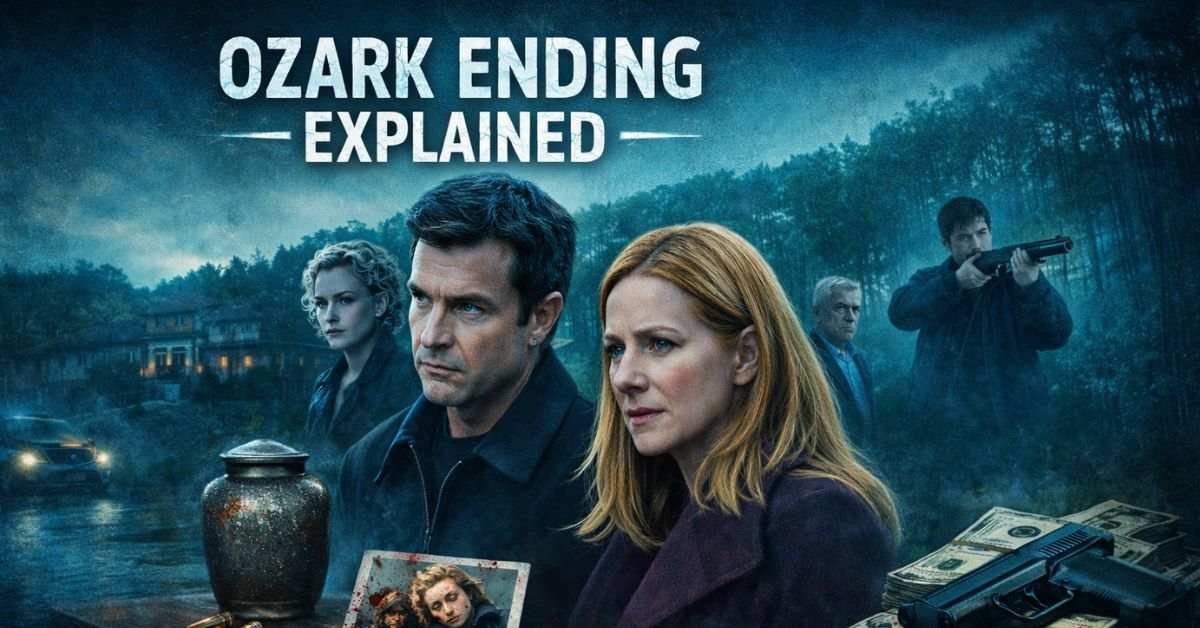
Here is what happens in the final phase of the finale:
- Camila Navarro confirms that Ruth Langmore killed Javi
- Camila confronts Ruth and shoots her
- The Byrdes believe they have finally made it through the cartel crisis
- They return home, where Mel Satem is waiting with Ben’s ashes
- Mel explains that he has figured out the truth about Ben’s death
- Jonah Byrde appears with a shotgun
- The screen cuts to black as the gun is fired
This sequence defines the Ozark because every final choice reveals the show’s real point. Ruth pays for revenge. Mel pays for getting too close to the truth. Jonah protects the family instead of opposing it. And Marty and Wendy once again survive by standing inside a structure built on fear, secrecy, and violence.
The ending is shocking, but it is not random. It is the final proof that the Byrdes no longer merely endure corruption. They now depend on it.
Why the Ozark ending feels so unsettling
The Ozark ending is disturbing because it is not tragic in the usual way. In many crime dramas, the final episode destroys the central family or punishes the main antiheroes. That kind of ending gives viewers a moral release. Ozark refuses to offer that comfort.
Instead, the Byrdes remain standing.
That choice makes the finale more uncomfortable than a mass-death ending would have been. A tragic collapse would have felt final. The ozark is more chilling because the family survives in a stronger position than before. They have suffered, but they have also adapted. Their damage has not weakened them. It has hardened them.
This is what gives the finale its lasting force. The Byrdes do not look like people who barely escaped. They look like people who learned how to win.
The real meaning behind the Ozark ending
The deeper meaning of the ozark ending is not just that crime can go unpunished. The series makes a more specific point than that. It suggests that power becomes even more dangerous when it learns how to look respectable.
By the end of the series, Marty and Wendy Byrde are no longer operating like desperate outsiders trying to survive a criminal machine. They have moved closer to legitimacy. They are tied to foundations, political relationships, public influence, and elite circles. They are laundering not just money, but identity.
That is the real achievement of the Byrdes in the ending. They turn criminal survival into social status.
This is also why the ending hits harder than a standard antihero finale. The Byrdes do not simply dodge consequences. They absorb criminal power into a more polished public form. They become the kind of people the world excuses, protects, and even admires from a distance.
Why Ruth’s death is the emotional core of the Ozark ending
No moment in the Ozark ending is more painful than Ruth Langmore’s death. For many viewers, Ruth represented the emotional center of the series. She was messy, impetuous, hurt, and fierce, but she also felt real in a society full of manipulation and performance.
That honesty is what made her different from the Byrdes.
Ruth did not hide behind polished speeches, strategic calm, or respectable image-making. Her emotions were visible. Her grief was visible. Her rage was visible. When she lost Wyatt, she did not turn that pain into strategy. She turned it into revenge. That choice eventually leads Camila to her.
What makes Ruth’s death so powerful in the ending is that it is not framed as meaningless shock. It grows directly out of her own decision to kill Javi. That gives her ending tragic weight. She is not randomly removed from the board. She is destroyed by the same violent world the Byrdes learned to manage more successfully.
There is also a deeper social reading here. Ruth tries, in the final stretch, to imagine a better life. Her record is cleared. Her future briefly opens up. But in the moral universe of Ozark, people like Ruth are rarely the ones protected by systems of power. They are the ones sacrificed by them.
That contrast is central to the ending. Ruth has emotional truth, but the Byrdes have structural power. And in the end, structure wins.
Why Jonah’s final choice changes the meaning of the whole series
Jonah Byrde’s final action is one of the most important pieces of the Ozark ending because it completes the family’s transformation.
For much of the series, Jonah seems like the Byrde most likely to reject the family’s corruption. He sees the hypocrisy in his parents. He responds strongly to Ben’s death. He appears emotionally separate from Wendy in particular. Viewers could reasonably hope that Jonah would become the line the family could not cross.
The finale destroys that hope.
When Jonah raises the shotgun at Mel, the moment does more than create suspense. It reveals that the Byrdes’ criminal logic has already passed into the next generation. Jonah is no longer standing outside the system. He is defending it.
That is why the Ozark ending feels larger than one final implied murder. The scene tells viewers that the family is not merely surviving in the present. It is carrying its moral corruption into the future.
Jonah’s choice also gives the ending a terrible kind of unity. The Byrdes spent much of the series fractured, angry, and mistrustful. In the final moment, they are brought together not by healing, but by shared violence.
What the ending says about Marty and Wendy
The Ozark ending works so well because it completes both Marty and Wendy in different ways.
Marty Byrde
Marty survives because he always knows how to adapt. He stays emotionally controlled, calculates risk quickly, and rarely allows panic to override strategy. But the finale shows the limit of that pragmatism. His intelligence keeps the family alive, yet it also helps normalize every compromise that destroys them morally.
Wendy Byrde
Wendy survives because she understands ambition more clearly than anyone else in the family. She sees power not as a temporary tool, but as a destination. Throughout the series, she makes increasingly extreme decisions while telling herself they are necessary for the family’s future. By the finale, that future exists, but it is built on irreversible damage.
Together, Marty and Wendy represent two sides of the same engine:
- Marty makes corruption functional
- Wendy makes corruption aspirational
That combination is why the Byrdes are so hard to defeat. The ending does not show two broken people clinging to life. It shows two people whose worst qualities now fit together perfectly.
Who wins and who loses in the Ozark ending?
| Character | Final outcome | What it really means |
| Marty Byrde | Survives and keeps influence | Pragmatism defeats morality |
| Wendy Byrde | Preserves power and family control | Ambition is rewarded |
| Jonah Byrde | Protects the family with violence | Corruption becomes inherited |
| Charlotte Byrde | Remains inside the family unit | Complicity becomes normal |
| Ruth Langmore | Killed by Camila | Humanity pays the highest price |
| Mel Satem | Silenced at the end | Truth has no power without protection |
This table helps explain why the ozark ending feels so harsh. It is not based on fairness. It is based on hierarchy. Those with less protection suffer more. Those with more influence endure.
Does it look like the Byrdes got away with it?
In practical terms, yes. That is one of the hardest truths inside the Ozark ending.
The Byrdes survive the cartel struggle. They maintain their public position. They remove the final direct threat in Mel. They keep their family together. If you judge the finale by external outcomes, they win.
But the show is careful not to present that victory as clean.
The Byrdes are alive, yet spiritually hollowed out. Their unity now depends on shared secrecy and moral collapse. Jonah’s final action does not rescue the family’s innocence. It confirms that innocence is gone.
So yes, they get away with it in the visible sense. But the ending also makes it clear that what survives is no longer a normal family. It is a fully transformed power unit.
Surface ending vs deeper meaning
| What viewers see | What it actually means |
| The Byrdes survive | They survive by fully embracing corruption |
| The family stands together | Their unity now depends on violence and secrecy |
| Jonah comes back to the family | He loses the last trace of moral distance |
| Wendy gets her family back | She gets control, not peace |
| The immediate crisis ends | The deeper moral collapse is complete |
This contrast is the key to reading the ending correctly. The finale is not saying the Byrdes are happy. It is saying they are established. In the world of Ozark, that can matter more.
Common mistakes people make when explaining the Ozark ending
A lot of articles and discussions weaken their analysis by focusing on the wrong questions. These are the most common mistakes.
Treating the cut to black as the only mystery
The ending is not mainly about whether Jonah fired. The scene strongly points to yes. The more important issue is what Jonah’s choice means for the family’s identity.
Saying Ruth died only for shock value
Ruth’s death is heartbreaking, but it is rooted in consequence. Her revenge on Javi carries forward into the finale. That gives her death tragic logic, not empty surprise.
Reading the ending as simple “crime pays”
The ending is more layered than that. It is about how crime, wealth, class, and legitimacy can blend together until consequences become negotiable.
Ignoring the class and power dynamic
One of the most important contrasts in the finale is between the Byrdes and Ruth. One side has access, polish, and strategic protection. The other has pain, courage, and far less institutional shielding.
Pro tips for writing or understanding the Ozark ending better
If you want a sharper reading of the ozark ending, focus on these points:
- Compare Ruth and Wendy as opposite forms of strength
- Notice how often official institutions fail to stop the Byrdes
- Track how family unity becomes stronger as morality becomes weaker
- Read the ending as a statement about legitimacy, not just criminality
- Think about why the family’s final victory feels so emotionally empty
These details help explain why the finale still stands out. The ending is not powerful because it surprises viewers once. It is powerful because it changes how the whole series looks in retrospect.
Why the Ozark ending still divides viewers
The ending remains divisive because it chooses thematic honesty over emotional satisfaction.
Some viewers think the finale is brilliant because it is bold, cold, and perfectly aligned with the show’s worldview. Others think it is frustrating because Ruth dies while the Byrdes survive. That reaction is understandable. Ruth is the character many viewers cared about most deeply, so her death naturally feels more personal than the Byrdes’ success feels clever.
But that discomfort is exactly what gives the finale its power.
The ending is not trying to make viewers cheer. It is trying to make them sit with an ugly idea: powerful people often survive not because they are right, but because they are protected by systems that bend around them.
That is why the ending stays memorable. It is not comforting, yet it feels disturbingly believable.
FAQs
What is the meaning of the Ozark ending?
The ending suggests that power, wealth, and influence can protect people from consequences, even after deep moral corruption.
Does Jonah kill Mel in the Ozark ending?
Yes, the ending strongly implies that Jonah shoots Mel in order to protect the Byrde family and its secrets.
Why does Ruth die in the Ozark ending?
Ruth dies because Camila discovers that Ruth killed Javi. Her death is the final consequence of that revenge.
Do Marty and Wendy win in the end?
Yes, in practical terms they do. They survive, protect their influence, and keep the family intact, though at the cost of whatever morality remains.
Why is the Ozark ending controversial?
It is controversial because it denies viewers traditional justice. Ruth dies, while the Byrdes move forward with power and protection.
Why is Jonah’s final moment so important?
Because it shows that the family’s corruption has passed to the next generation. He does not reject the Byrdes’ world. He secures it.
Is the Ozark ending realistic?
Within the show’s world, yes. Its realism comes from how convincingly it shows power shielding people from accountability.
Conclusion
The Ozark ending is powerful because it does not pretend justice always wins. Instead, it presents a darker and more realistic possibility: the people who understand power, shape public image, and protect their interests often keep going, no matter how much damage they cause.
That is why the finale works so well. The Byrdes do not simply escape danger. They complete a transformation. By the final scene, they are no longer a family trapped in crime. They are a family united by it.
In the end, the ozark is not really about closure. It is about what happens when survival becomes more important than truth, innocence, and humanity.
Visit the rest of the site for more interesting and useful articles.