

 By
By Introduction
Islamic quotes can comfort the heart, correct behavior, and bring a person back to Allah in both easy and difficult times. But one major problem online is that many quote collections mix Qur’an, authentic hadith, scholar sayings, and unsourced social media lines as if they all carry the same weight. A better article should separate them clearly and give readers words they can trust.
That matters because faith-based reminders are not only decorative. Pew reported in 2025 that 59% of Muslim adults in the United States say they pray several times a day, and another 28% say they pray regularly but less often. In a broader 2025 Pew survey across 35 countries, Muslims in nearly every country with enough data were more likely than other religious groups to pray daily.
Research also suggests that engagement with the Qur’an may support emotional well-being in some settings. A 2022 review indexed by PubMed found favorable effects from listening to, reciting, or memorizing the Qur’an on outcomes such as anxiety, depression, physiologic measures, and quality of life, though that does not replace qualified medical care when it is needed.
What are Islamic quotes?
Islamic quotes are words rooted in Islamic teaching that remind people of faith, worship, mercy, patience, character, gratitude, and accountability. The strongest Islamic quotes come directly from the Qur’an and authentic hadith. After that come scholar explanations and reflections, which can still be useful, but they should never be presented as revelation.
People search for Islamic quotes for many reasons. Some want comfort during hardship. Others want captions, reminders, or short lines they can share with family and friends. The best content does more than list pretty sentences. It helps readers understand which Islamic quotes are authentic, what they mean, and how to use them correctly in real life.
What makes Islamic quotes trustworthy?
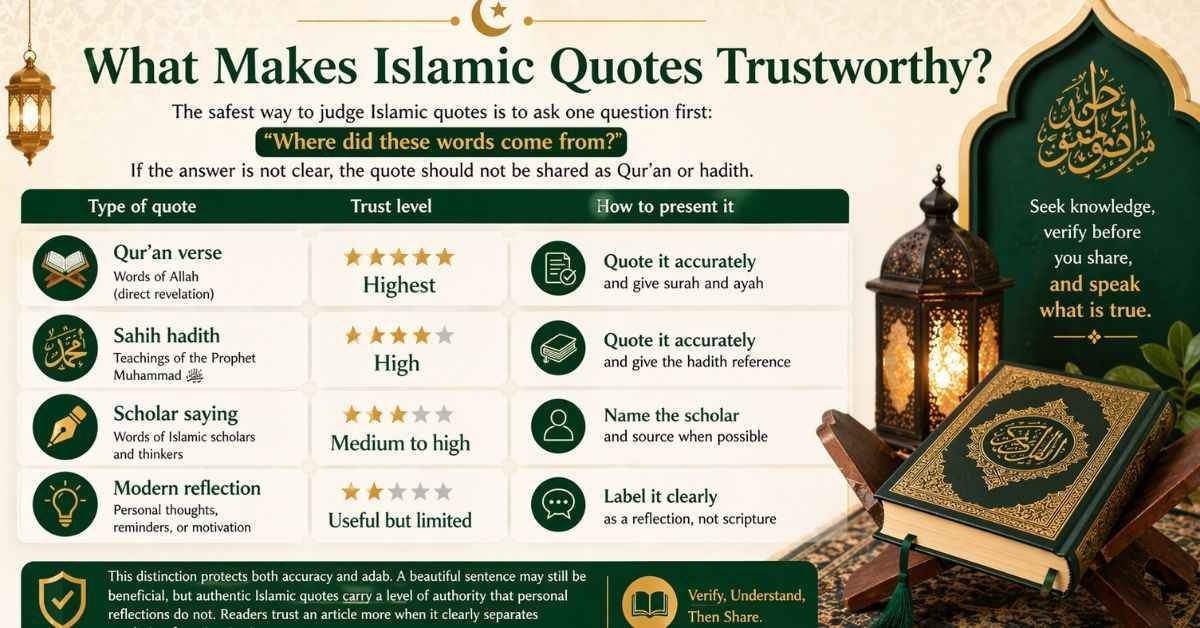
The safest way to judge Islamic quotes is to ask one question first: Where did these words come from? If the answer is not clear, the quote should not be shared as Qur’an or hadith.
| Type of quote | Trust level | How to present it |
| Qur’an verse | Highest | Quote it accurately and give surah and ayah |
| Sahih hadith | High | Quote it accurately and give the hadith reference |
| Scholar saying | Medium to high | Name the scholar and source when possible |
| Modern reflection | Useful but limited | Label it clearly as a reflection, not scripture |
This distinction protects both accuracy and adab. A beautiful sentence may still be beneficial, but authentic Islamic quotes carry a level of authority that personal reflections do not. Readers trust an article more when it clearly separates revelation from inspiration.
8 authentic Islamic quotes every Muslim should know
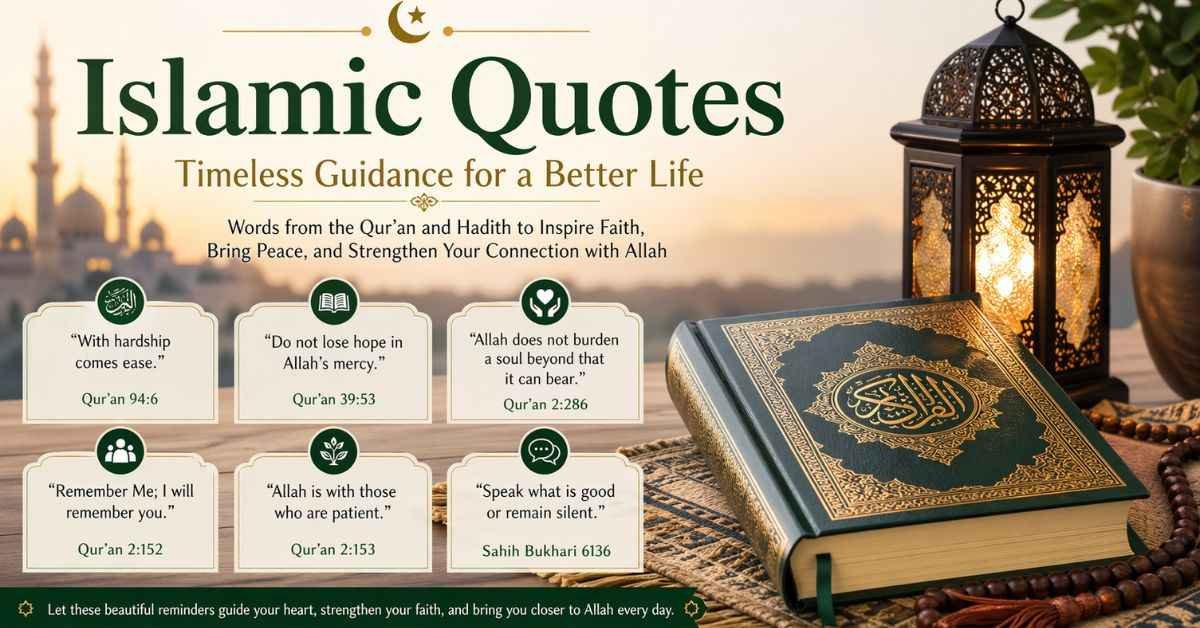
“With hardship comes ease”
This is one of the most loved Islamic quotes because it speaks directly to pressure, grief, fear, and uncertainty. The verse appears in Surah Ash-Sharh and repeats the message of ease after hardship, which gives the believer hope without denying the reality of struggle. It is a reminder that difficulty is never the full story.
“Do not lose hope in Allah’s mercy”
This verse from Surah Az-Zumar is one of the strongest Islamic quotes for people carrying guilt, regret, or spiritual weakness. It calls sinners back to hope and warns against despair. For many readers, this is the line they need when they feel they have gone too far. In Islamic teaching, hopelessness is not a sign of strength. Returning to Allah is.
“Allah does not require of any soul more than what it can afford”
Among all Islamic quotes about tests and hardship, this verse from Surah Al-Baqarah gives deep emotional balance. It does not say life is easy. It says your burden is known to Allah. This verse helps believers stay patient, do what they can, and avoid collapsing under pressure.
“Remember Me; I will remember you”
This short verse is one of the simplest and most powerful Islamic quotes about dhikr. It shows that remembrance is not empty repetition. It is a relationship between the servant and the Lord. In daily life, this verse makes even small acts of remembrance feel weighty and personal.
“Allah is truly with those who are patient”
This verse links patience with prayer and teaches believers where to seek help first. Sabr in Islam is not a passive weakness. It is disciplined steadiness in worship, speech, and decision-making. That is why this remains one of the most practical Islamic quotes for family stress, illness, delayed goals, and personal trials.
“Actions are judged by intentions”
This hadith is a foundation of Islamic living. It explains why two people can do the same outward act and receive different spiritual outcomes. For students, workers, parents, business owners, and content creators, this is one of the most important Islamic quotes to revisit regularly. It turns routine effort into worship when the intention is sincere.
“The real patience is at the first stroke of a calamity”
This hadith defines true sabr with precision. Patience is not only what comes later, after a person has calmed down. Real patience appears in the first shock. That is why this is one of the clearest Islamic quotes for grief, bad news, conflict, and sudden emotional pain.
“Speak what is good or keep silent”
This hadith feels especially relevant today because speech now includes texting, posting, commenting, forwarding, and replying. One careless sentence can damage trust, family ties, or someone’s honor. Among short Islamic quotes, this one is one of the most practical for daily discipline online and offline.
Which Islamic quotes help in different situations?
| Situation | Best type of Islamic quotes | Why they help |
| Stress or hardship | Ease, sabr, reliance | They give hope while keeping the heart steady |
| Guilt or regret | Mercy, forgiveness, tawbah | They pull a person away from despair |
| Anger or arguments | Speech, patience, character | They protect relationships and reduce harm |
| Low motivation | Intention, gratitude, righteous action | They reconnect daily effort to worship |
| Family life | Mercy, manners, self-control | They improve conduct, not just feelings |
This is where many weak articles fail. They collect Islamic quotes without showing readers when and why each one matters. A stronger article helps readers choose the right reminder for the right moment instead of treating every quote the same way.
How to use Islamic quotes in daily life
The most beneficial way to use Islamic quotes is to connect them to action. Read one after Fajr and choose one habit to improve that day. Share one with your family and explain the source. Keep a small notebook of authentic verses and hadith for the moments you feel weak, angry, anxious, or distracted. A quote becomes more powerful when it changes behavior, not just mood.
You can also use Islamic quotes in teaching children. Short source-based reminders about patience, honesty, gratitude, and kind speech are easier to remember than long lectures. For adults, posting authentic Islamic quotes with the reference included is far better than circulating attractive but unsourced text graphics.
Common mistakes people make with Islamic quotes
Sharing unsourced words as hadith
This is one of the biggest mistakes. If a line sounds beautiful but has no verified source, do not present it as prophetic speech.
Using Islamic quotes without context
A verse or hadith may be real but still misunderstood when pulled away from its setting. Good content explains meaning, not just wording.
Treating all quote types as equal
Qur’an, hadith, scholar sayings, and social reflections are not on the same level. A clear article keeps those categories separate.
Choosing emotional lines over accurate ones
Some writers focus on viral wording instead of sound sourcing. That may perform briefly on social media, but it weakens trust and educational value over time.
Pro tips for choosing better Islamic quotes
- Start with the Qur’an before anything else.
- Use sahih hadith for practical daily reminders.
- Keep the wording accurate and short.
- Add the reference every time.
- Read the full verse or hadith before explaining it.
- Use scholar sayings only when they are properly attributed.
- Label modern reflections honestly.
These simple habits improve both trust and usefulness. They also make Islamic quotes more beneficial for search readers who want real guidance, not just recycled lines.
FAQs
What are the most authentic Islamic quotes?
The most authentic Islamic quotes are direct Qur’an verses and sahih hadith with clear references.
Can I post Islamic quotes without a source?
You can post a personal reflection without a source, but do not label it as Qur’an or hadith unless it is verified.
Which Islamic quotes help during hard times?
Verses and hadith about ease, patience, mercy, and reliance are especially helpful during hardship.
Are all social media Islamic quotes reliable?
No. Many viral Islamic quotes are paraphrases, unattributed sayings, or original reflections.
Can Islamic quotes support emotional well-being?
They can offer spiritual comfort, and research reviews suggest Qur’an engagement may help in some settings, but serious mental or physical health issues still need proper professional care.
What is the safest kind of Islamic quote to share?
A short Qur’an verse or sahih hadith with a correct reference is usually the safest and most beneficial choice.
Conclusion
The best Islamic quotes do more than sound beautiful. They teach patience when life is heavy, mercy when a person feels guilty, restraint when anger rises, and sincerity in ordinary daily work. That is what makes them timeless.
If you want to build a trustworthy collection of Islamic quotes, use this order: Qur’an first, authentic hadith second, scholar wisdom third, personal reflections last. That one habit makes your reading, writing, and sharing more accurate, more useful, and more pleasing to Allah.
Visit the rest of the site for more interesting and useful articles.